-
The Unconstrained Ear Recognition Challenge 2026 — Size matters: Ear Biometrics on Edge (UERC 26)
The 3rd Unconstrained Ear Recognition Challenge (UERC) is organized in the scope of the International Joint Conference on Biometrics 2023. The goal of the challenge is to further advance the state-of-technology in the field of automatic ear recognition, to provide participants with a challenging research problem and introduce a benchmark dataset and protocol for assessing the latest techniques, models, and algorithms related to automatic ear recognition.The results of UERC 2026 will be published in the IJCB conference paper authored jointly by all participants of the challenge that perform above the baseline.For Participants
General Info
UERC 2026 is organized as a two-track competition, where each track is focused on one specific goal. Participants are free to enter only a single track or compete in both. For each track, a dataset, evaluation tool written in Python, and baseline models in Python are made available. A detailed description of the two tracks is given below:- Track 1: Lightweight Model Design. The first UERC 2026 evaluation track will collect compact ear recognition models and score their performance on ear images captured in unconstrained environments. The performance indicators will include a measure of recognition accuracy as well as quantitative measures of model complexity, such as the number of parameters and model size (memory footprint). These components will jointly contribute to the overall ranking, encouraging participants to design efficient architectures without imposing strict hard limits. Participants will be free to develop any type of model to maximize recognition performance while reducing model complexity through architectural design, pruning, quantization, distillation, or other optimization strategies. The final submission for this track will include a working solution (source code or compiled binary), which the organizers will execute to evaluate recognition performance and compute complexity measures on a sequestered test dataset.
- Track 2: Edge Deployment. The second UERC 2026 track will focus on practical deployment efficiency under fixed hardware conditions. All submitted solutions will be executed on a standardized Raspberry Pi 4 platform in a CPU-only configuration. The evaluation will combine recognition accuracy with measured inference time per image, reflecting real-world edge constraints. Participants will be required to submit a complete runnable solution, which the organizers will deploy and benchmark under identical conditions on the sequestered test data. This track emphasizes robust and efficient implementation suitable for low-power embedded systems while maintaining competitive recognition performance. All submissions will be evaluated on a Raspberry Pi 4 Model B (Revision 1.2) with 4 GiB RAM. The device uses a Broadcom BCM2711 quad-core Cortex-A72 CPU at 1.5 GHz and runs a 64-bit Raspberry Pi OS (Debian Trixie port). Inference will be performed CPU-only, with no GPU or NPU acceleration, and the batch size is fixed to 1. Timing is measured under a standardized protocol after a warm-up phase, with thermal throttling disabled and background processes minimized. Only the feature extraction process will be executed as part of the evaluation.
Data, Training and Model Development
For the training and model development two main sources of data are available to the UERC 2026 participants:- A dataset used for UERC 2023 of around 14,000 collected images as well as the training and testing images from UERC 2017 and 2019, and
- over 234,000 images of around 600 subjects from the VGGFace-Ear dataset.
The training set is available for model training and hyperparameter selection. Additionally, part of the training data is split from the training set to allow the participant to estimate their performance (in terms of verification errors as well as bias) during model development.The testing data is sequestered and not made available to the participants.
The images used for UERC 2026 are the same as for UERC 2023, enabling easy
comparison.
Organizers
- Asst. Prof. Žiga Emeršič
University of Ljubljana, Faculty of Computer and Information Science, Slovenia, EU - Assoc. Prof. Diego Sušanj
Juraj Dobrila University of Pula, Faculty of Engineering, Croatia, EU - Prof. Hazım Kemal Ekenel
Istanbul Technical University, Department of Computer Engineering, Turkey - Prof. Guillermo Camara-Chavez
Federal University of Ouro Preto, Brazil - Prof. Peter Peer
University of Ljubljana, Faculty of Computer and Information Science, Slovenia, EU - Prof. Vitomir Štruc
University of Ljubljana, Faculty of Electrical Engineering, Slovenia, EU
Important Dates
- March 17: Registration opens.
- April 1: Kick-off.
- May 4: First interim ranking.
- May 8: Second interim ranking.
- May 15: Registration closes and competition ends.
- May 30: Summary paper submission.
If you have any questions, suggestions or would like to participate in the future
competitions, feel free to contact ziga.emersic@fri.uni-lj.si.
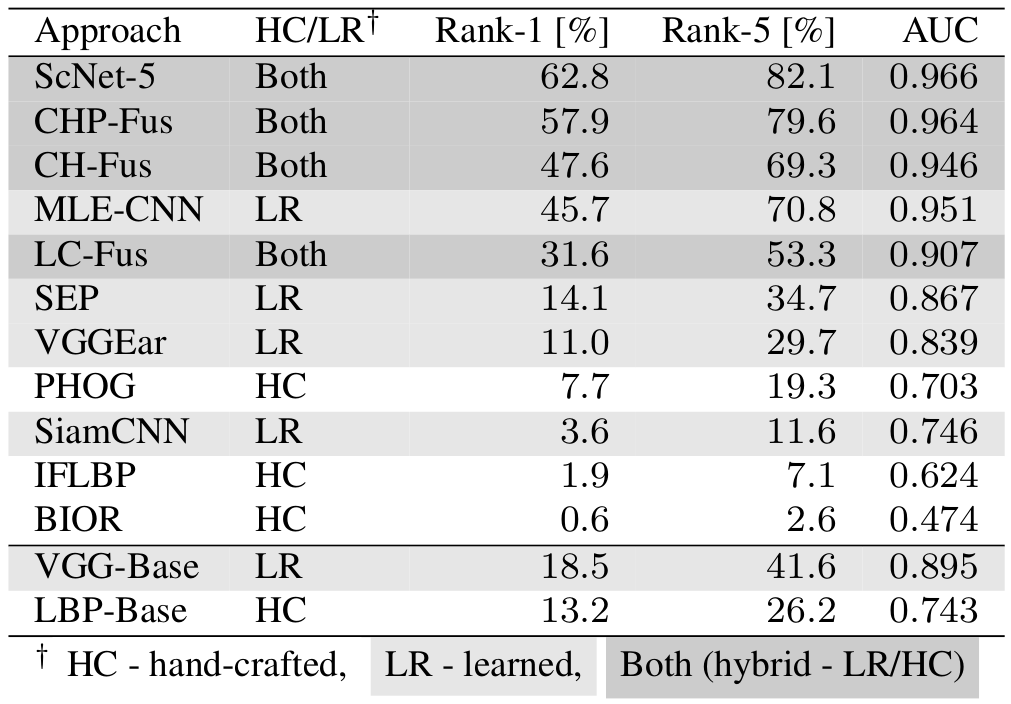
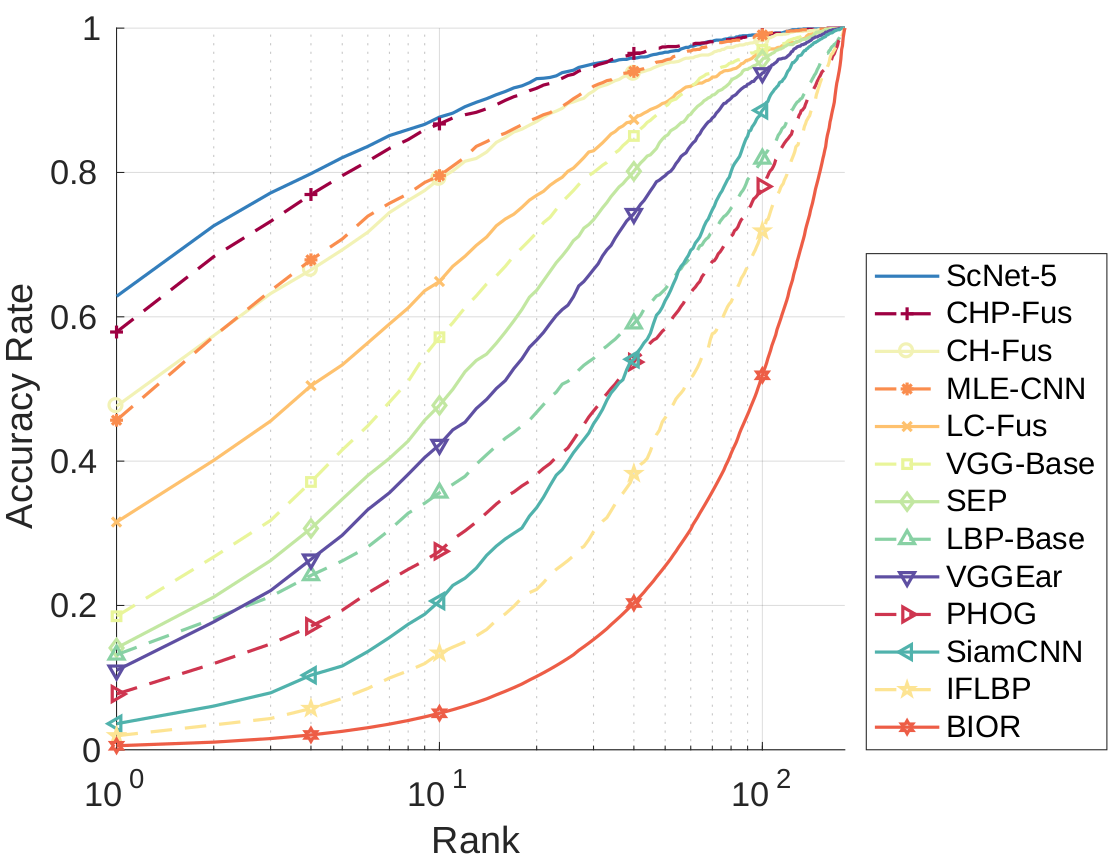 CMC curves of the submitted approaches generated on the testing split of the
AWEx dataset (shown in log-arithmic scale). The legend on the right is sorted
accordingto the rank-1 performance.
CMC curves of the submitted approaches generated on the testing split of the
AWEx dataset (shown in log-arithmic scale). The legend on the right is sorted
accordingto the rank-1 performance.
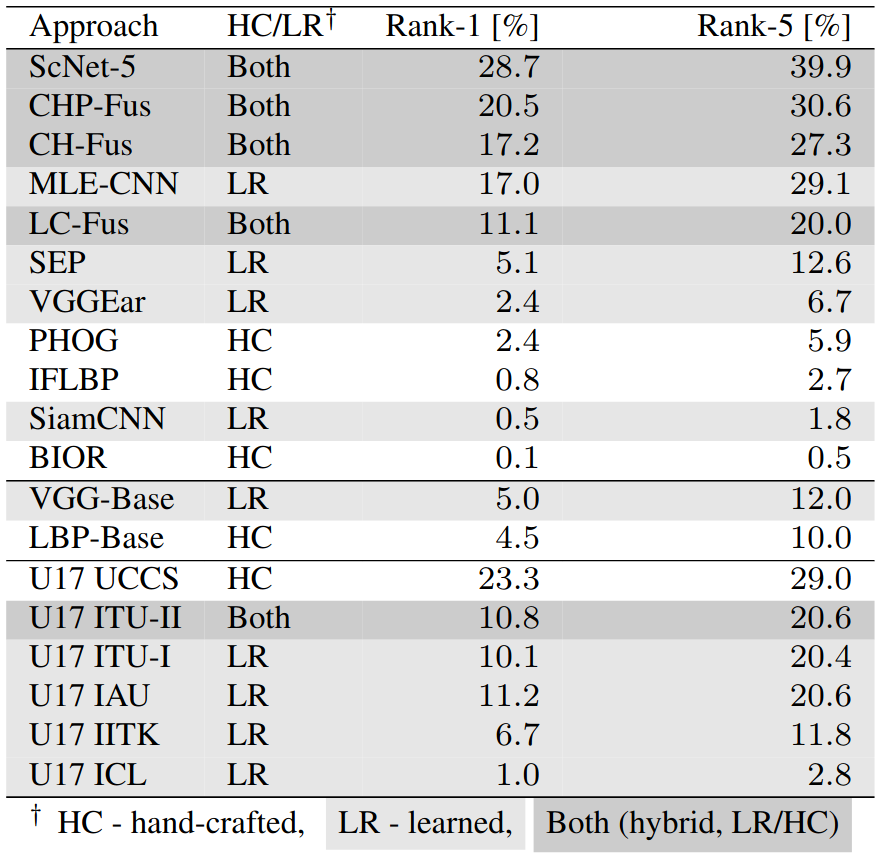
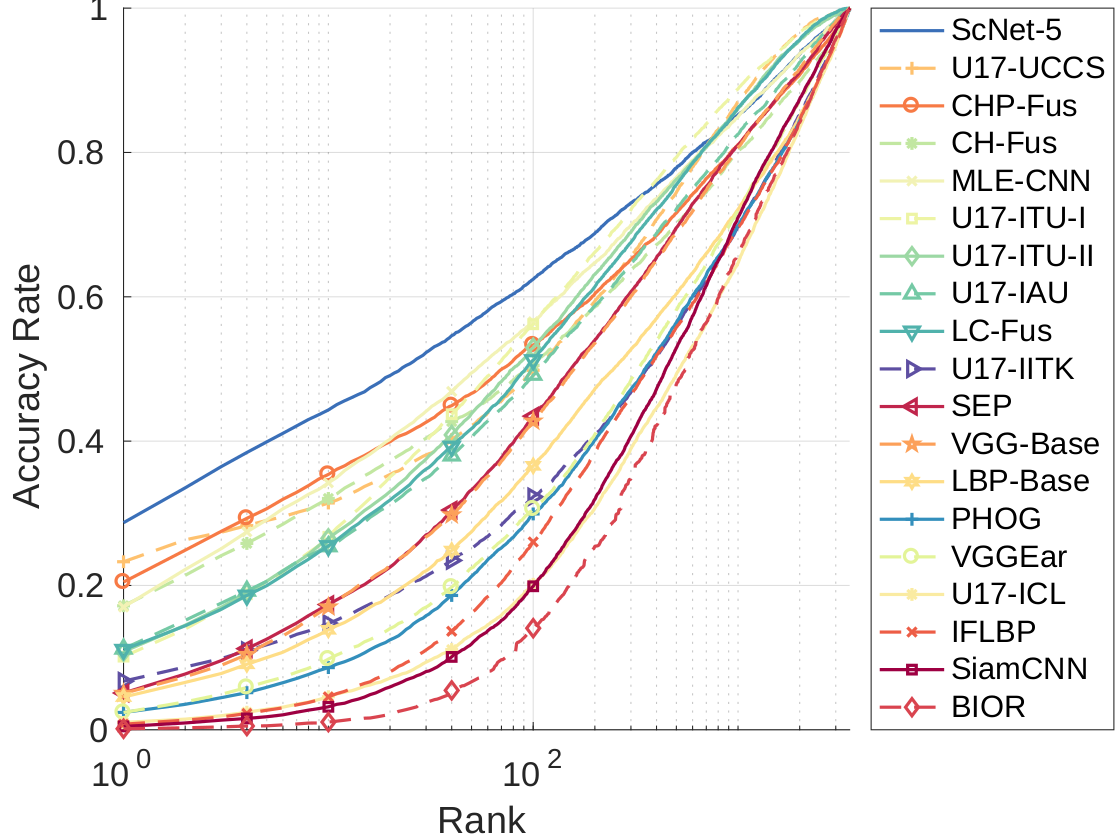 CMC curves of the submitted approaches generated on the complete UERC test
dataset involving 3,540 subjects (shown in logarithmic scale). The legend is
sortedaccording to the rank-1 scores. U17 denotes approachesfrom UERC 2017.
CMC curves of the submitted approaches generated on the complete UERC test
dataset involving 3,540 subjects (shown in logarithmic scale). The legend is
sortedaccording to the rank-1 scores. U17 denotes approachesfrom UERC 2017.
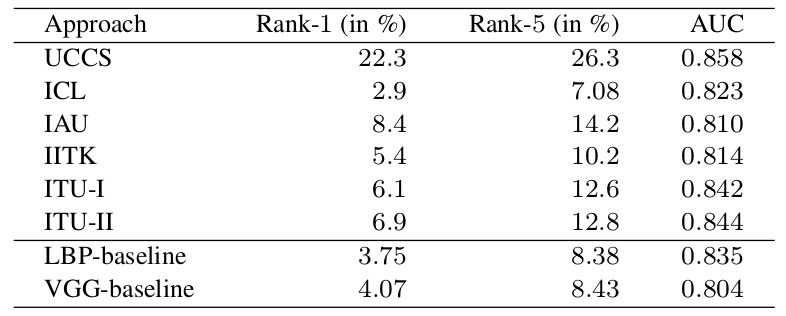
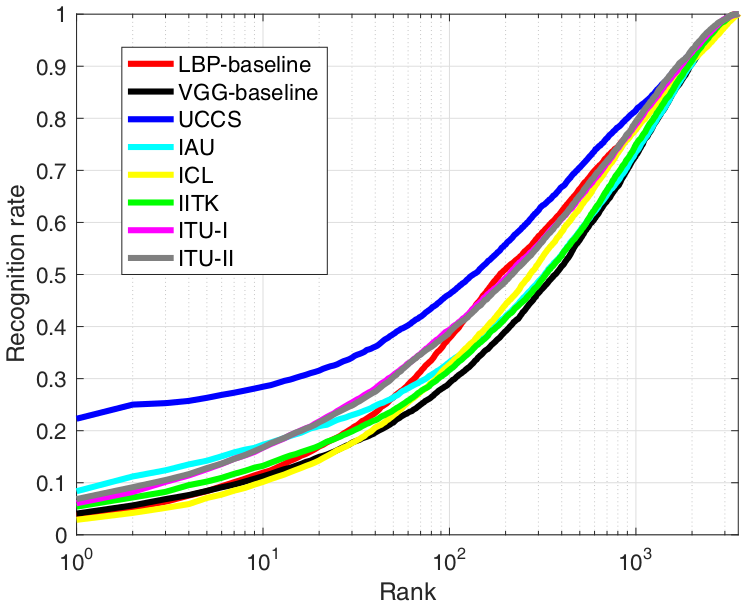 CMC curves of the scalability experiments on the entire UERC dataset. The rank
of the experiments is plotted on a logarithmic scale to better highlight the
performance at the lower ranks.
CMC curves of the scalability experiments on the entire UERC dataset. The rank
of the experiments is plotted on a logarithmic scale to better highlight the
performance at the lower ranks.